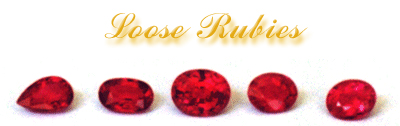

Loose Rubies

Rubies

Ruby Gemstones

Rubies - The Ross Jewelry Company
Click here to learn about us
Click here to contact us
Click here for the best links on the Web to learn about jewelry
Click here to view our store hours
Click here to for directions and a map
Loose Rubies in Atlanta

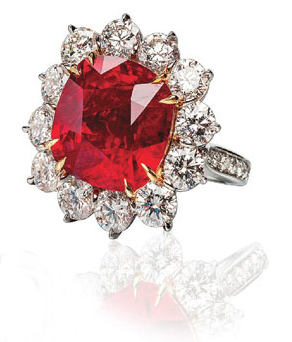
Burbese Ruby displaying characteristic red color

Star Ruby displaying asterism
Loose Rubies: Rubies - Ruby Gemstones in virtually any grade and price range are available at
The Ross Jewelry Company in Atlanta, Georgia.

Loose Rubies - Rubies: Ruby the usual name for transparent red corundum.  On this page, we will often use the word corundum to include Rubies and sapphires, because of their shared characteristics.  Rubies are red.  Blue or any other color of corundum is usually called sapphire.

Corundum
Corundum is the mineralogical name for aluminium oxide.

Rubies - Coloration
Corundum can be colorless, red, pink, red, black, brown, orange, yellow, green, indigo, violet, or mauve.  Red corundum is called Ruby, while pink and all other colors are called sapphire.  Usually, with the color specified as a prefix to the word sapphire, for example, Yellow Sapphire.

Pure corundum is colorless, often called white, and although quite rare, tends not to be valuable because it does not have much brilliance.  Colors, as in many gemstones, are caused by small amounts of impurity, usually metallic oxides.  This is a case where impurity is desirable.

Chromic oxide causes brilliant red coloring in corundum, thereby producing Rubies.  Ferric oxide causes yellow colouration, titanium oxide produces vivid red.  In fact, the coloration in Rubies is not quite so simple as this.  The titanium and iron are usually present in the form of ilmenite, a mineral which is a titanium iron oxide, TiFeO3.  Ilmenite is not isomorphous with aluminium oxide.  Isomorphous means being able to replace the host mineral within its crystal structure.  Instead ilmenite is present as a microscopic inclusion, in the form of colloidal particles.  This colloidal nature may be responsible for other optical effects such as "silk", asterism, and color banding.

Microscopic inclusions, sometimes called "silk", are a normal characteristic of Rubies.  However, heating tends to dissolve these inclusions. The existence of inclusions provides traces to the origin of Rubiesand can be used to separate natural from synthetic stones.  The inclusions within these gemstones may also be evidence that a Ruby has not been heat-treated.  Inclusions do not affect the value of the stone as long as the brilliance of the gemstone is maintained and they are not visible to the naked eye.  Intensity and uniformity of the red color are the factors used to determine the price of Rubies.  Highly valued Rubies are those with intense medium red and uniformed color.  Intense pink Rubies can be highly appraised as well, if they are clear and beautifully cut.

Rubies - Durability
Corundum is very hard, having a hardness of 9 on Moh's scale, compared with 10 for diamond, and 8 for topaz.
Hardness is generally a desirable feature is gemstones.

Other uses for corundum, because of its hardness, are as watch bearings, watch glasses, and as an abrasive.

Rubies - Sources
Originally, the best Rubies came from Burma, where they are believed to have been mined possibly from prehistoric times.  Certainly they appear to have been worked during the times of Marco Polo.

Thailand, previously called Siam, is an important source of attractive Ruby.  Thai Rubies are usually not intense, often slightly pale and silky.

Rubies - Pricing
The price range of loose Rubies is very large, ranging from under a few dollars per carat to many thousands of dollars per carat, depending primarily on color, but also on brilliance, which is affected by clarity and cutting.  Large, brilliant Rubies are very rare and expensive.

Rubies - Finest and Most Valuable Color
Many people seem to believe that the darker the Ruby the better. Just as many seem to believe the opposite. Neither of these opinions is correct.  If you think, even briefly, about this it becomes obvious why.  A very dark ruby would appear black, and would not be very attractive or desirable.  The darkness often being caused by inclusions.  An extremely pale ruby would be colorless, and not particularly attractive or valuable.

As usual, the truth lies between the two extremes.  The most desirable Rubies are generally those with an intense red color, and plenty of sparkle and life.  These latter two factors are usually helped by high optical clarity and skillful cutting.

Ultimately which is "best" is a subjective matter, and personal preference is important.  Our typical advice to potential customers is to buy whichever color of Ruby they personally find the most attractive.

Rubies - Care and Cleaning
Ruby Jewelry can be cleaned using hot soapy water, or detergent, rinse thoroughly afterwards as detergents can cause dermatitis and allergic reactions.  Enzyme cleaners should be avoided for the same reasons.  Brushing with an old tooth brush to remove dirt and grease will also help.

Technical Characteristics

Chemical Composition: Al2O3 - Aluminium Oxide
Hardness: 9
Specific Gravity: 3.96 - 4.01
Refractive Index (R.I.): 1.759 - 1.767 to 1.770 - 1.779
Bi-refringence: 0.009
Crystal Structure: Trigonal

The Ross Jewelry Company - 7 Piedmont Center, Suite 104 - Atlanta, Georgia - (404) 495-3720

We are proud members of the following jewelry industry organizations:


Click here to return to Ross Jewelry Company's Home Page
Click here to go back one page

Copyright © 1999-2008 - Loose Rubies - The Ross Jewelry Company, Incorporated  Atlanta, Georgia.  All rights reserved.