
Emeralds - The Ross Jewelry Company

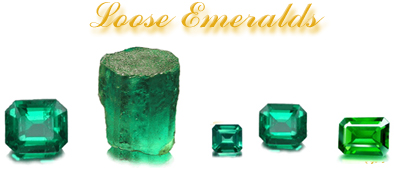
Loose Emeralds

Emeralds

Emerald Gemstones

Click here for our Home Page
Click here to learn about us
Click here to contact us
Click here for the best links on the Web to learn about jewelry
Click here for our Home Page
Click here to view our store hours
Click here to for directions and a map

Rough Emerald

Emerald
Loose Emeralds: Emeralds - Emerald Gemstones in virtually any grade and price range are available at
The Ross Jewelry Company in Atlanta, Georgia.

Loose Emeralds are the grass green variety of the gemstone called beryl.  Although all Emeralds are beryl, not all beryls are emerald (see Beryl).

Emeralds - Coloration
Pure beryl is colorless, often called white, and although quite rare, tends not to be valuable because it does not have much brilliance. Colors, as in many gemstones, are caused by small amounts of impurity, usually metallic oxides.  This is a another case where impurity is desirable.

Chromium, in the form of chromic oxide, causes the bright grassy green coloring in beryl, thereby producing Emeralds.  Vanadium can also affect the exact shade, as may traces of iron.  It is also possible to have green beryl which is not Emerald, because the coloring agent is not chromium.

Emeralds - Durability
Emerald, along with other beryls, is quite hard, having a hardness of 71/2 to 8 on Moh's scale, compared with 10 for diamond, 9 for corundum, and 8 for topaz.  Hardness is generally a desirable feature in gemstones because it relates directly to durability.

Emeralds - Sources
The earliest known source of Emerald was near the Red Sea in Egypt, the so-called Cleopatra's Emerald mines.  They were probably worked from about 2000 B.C., apparently the location of them was lost in the middle ages, and not rediscovered until 1818.  Most Emeralds used in ancient jewelry are believed to have come from these mines.  They are not currently worked because of the low quality of crystals found.

Emeralds have been found in Austria since Roman times, in the Legbach ravine at Habachtal near Salzburg.  These are no longer commercially mined.

Columbia is generally recognised as the source of the world's finest quality Emeralds, both in the past and the present.  The Columbian Indians were using them before 1537, when Quesada conquered Columbia.  Later the Spanish discovered that the Emerald mines were at Somondoco, which means "god of the green stones", and which is now known as Chivor.  The best colored Columbian Emeralds are said to be those from the Muzo mine, although another mine at Cosquez is also highly rated.

Russia has been another important source of Emeralds in the past. Most Russian Emeralds coming from Sverdlovsk or Ekaterinburg in the Ural Mountains.

Emeralds were discovered in Australia in 1890 in New South Wales.  They were discovered between 1927 and 1929 at Gravelotte in South Africa, followed by other sources.  Another important source of superb quality Emeralds, usually only of small size, is Sandawana in Zimbabwe formerly Southern Rhodesia.  These were discovered only in 1956.

Emeralds were known in India from antiquity, but their source is not certain.  The earliest known Indian source was 1929 at Arawalli in Rajahstan, other sources being discovered since.  The quality of Indian  emeralds is very variable, but most are of lower quality which are often polished as beads.

Other sources of Emerald include Norway, North Carolina, Connecticut, Maine, New Hampshire, although non of these are very important.

Emeralds - Pricing
The price range of loose emeralds is very large, ranging from under a few dollars per carat to many thousands of dollars per carat, depending primarily on color, but also on brilliance and clarity. Large, brilliant clear emeralds are very rare and expensive, in fact any clear emerald is quite scarce, regardless of size.

Many people have the opinion that the darker the Emerald . . . the better, just as many seem to believe the opposite. Neither of these opinions is correct.

A very dark Emerald would appear black, and would not be very attractive or desirable. The darkness often being caused by inclusions. An extremely pale emerald would be colorless, and not particularly attractive or valuable. The truth lies between the two extremes. The most desirable emeralds are generally those with an intense grassy green color, with obvious sparkle and life, and free of any inclusions. Some experts say that a dark velvety green is the most valuable. Ultimately which is "best" is a subjective matter, and personal preference is important. Our usual advice to potential customers is to buy whichever color of emerald they personally find the most attractive. We also think it's slightly sad that we need to give this advice. Buy what you like, using your own judgment, rather than allowing yourself to be a slave to fashion and buying what you think will impress other people.

The main choice in the color of emeralds depends largely whether you prefer lighter but brighter stones, or a deeper more intense color.

Emeralds - Treatment
The vast majority of emeralds are oiled, that is to say, immersed in oil which fills the many cracks and fissures to which emerald is prone. This has the effect of reducing the visibility of the inclusions, and improving the clarity of the stone. Sometimes oiling also improves the color. Green colored oil is sometimes used to enhance the stones natural color, there are also other fillers used which are more permanent than oil.

Because oil filling of emeralds has become almost universal, it is generally not considered essential to disclose this fact. We suggest that anyone wishing to buy a high quality or expensive emerald should request a gemstone laboratory certificate stating that the stone is natural and not oiled, but be prepared to pay extra for a certificated stone. Most modern emeralds are likely to be oiled at the mines, and again at the cutters.

Technical Characteristics

Chemical Composition: Be3Al2(SiO3)6 - Beryllium Aluminium Silicate
Hardness: 7.5 - 8
Specific Gravity: 2.65 to 2.76
Refractive Index (R.I.): 1.560 - 1.565 to 1.587 to 1.593
Bi-refringence: 0.005 to 0.009
Optic Sign: Negative
Optical Character: Uniaxial
Crystal Structure: Hexagonal

Loose Diamonds Atlanta - The Ross Jewelry Company
The Ross Jewelry Company - 5 Piedmont Center, Suite 110 - Atlanta, Georgia 30305 - (404) 495-3720

Experience and Credentials - The Ross Jewelry Company

Copyright © 1999-2009 - Loose Emeralds Atlanta - The Ross Jewelry Company, Incorporated - Atlanta, Georgia.  All rights reserved.